link AVIONICS

Interested in Avionics, Visit, http://avionics0.blogspot.com

Thursday, June 9, 2011

Thermal expansion valve

Thermal expansion valve(ATA 21)

A thermal expansion valve  is a component in refrigeration and air conditioning systems that controls the amount of refrigerant flow into the evaporator thereby controlling the superheat at the outlet of the evaporator. This is accomplished by use of a temperature sensing bulb filled with a similar gas as in the system that causes the valve to open against the spring pressure in the valve body as the temperature on the bulb increases. As temperatures in the evaporator decrease, so does the pressure in the bulb and therefore on the spring causing the valve to close. An air conditioning system with a TX valve is often more efficient than other designs that do not use one.

Wednesday, February 23, 2011

Self-sealing fuel tank


In aviation, self-sealing fuel tank is a fuel tank technology in wide use since World War II that prevents fuel tanks primarily on aircraft from leaking fuel and igniting after being damaged by enemy fire.
Self-sealing tanks have two layers of rubber, one of vulcanized rubber and one of untreated rubber that can absorb oil and expand when wet. When a fuel tank is punctured, the fuel will spill on to the layers, causing the swelling of the untreated layer, thus sealing the puncture.
Most jet fighters and all US military rotary wing aircraft have some type of self-sealing tanks. Military rotary wing fuel tanks have the additional feature of being crashworthy. High altitudes require the tanks to be pressurized, making self-sealing difficult. Newer technologies have brought advances like inert foam-filled tanks to prevent detonation. This foam is an open cell foam that effectively divides the gas space above the remaining fuel into thousands of small spaces; none of which contain sufficient vapour to support combustion. This foam also serves to reduce fuel slosh. Major manufacturers of this technology include Amfuel (Zodiac) (formerly Firestone), Engineered Fabrics Corp. (Meggitt) (formerly Goodyear), GKN USA and FPT Industries. For military use, tanks are qualified to MIL-DTL-27422 and MIL-DTL-5578.
In additions to fighter aircraft some military patrol vehicles and armoured limousines for VIP use also feature self-sealing fuel tanks.

Monday, February 14, 2011

Wingtip device


Wingtip devices are usually intended to improve the efficiency of fixed-wing aircraft. There are several types of wingtip devices, and though they function in different manners, the intended effect is always to reduce the aircraft's drag by altering the airflow near the wingtips. Wingtip devices can also improve aircraft handling characteristics and enhance safety for following aircraft. Such devices increase the effective aspect ratio of a wing without materially increasing the wingspan. An extension of span would lower lift-induced drag, but would increase parasitic drag and would require boosting the strength and weight of the wing. At some point, there is no net benefit from further increased span. There may also be operational considerations that limit the allowable wingspan (e.g., available width at airport gates).
Wingtip devices increase the lift generated at the wingtip (by smoothing the airflow across the upper wing near the tip) and reduce the lift-induced drag caused by wingtip vortices, improving lift-to-drag ratio. This increases fuel efficiency in powered aircraft and increases cross-country speed in gliders, in both cases increasing range.

Winglets are employed on many aircraft types, such as:
  • Rutan VariEze, the first aircraft to use winglets (1975)
  • Learjet 28/29, the first production jet aircraft to use winglets (1977)
  • Glaser-Dirks DG-303, an early glider derivative design, incorporating winglets as factory standard equipment
  • Airbus A310-300, the first airliner to feature wingtip fences (1985)
  • Boeing 747-400, the first mainline airliner to feature winglets (1988)
  • Ilyushin Il-96, first Russian and modern jet to feature winglets (1988)
  • Tupolev Tu-204, first narrow body aircraft to feature winglets (1994)


Monday, December 27, 2010

Lightning detection

A lightning detector is a device that detects lightning produced by thunderstorms. There are three primary types of detectors: ground-based systems using multiple antennas, mobile systems using a direction and a sense antenna in the same location (often aboard an aircraft), and space-based systems.


For more http://avionics0.blogspot.com/2010/12/lightning-detection.html

Saturday, November 13, 2010

Flaps

Flaps are hinged surfaces on the trailing edge of the wings of a fixed-wing aircraft. As flaps are extended, the stalling speed of the aircraft is reduced, which means that the aircraft can fly safely at slower speeds (especially during take off and landing). Flaps are also used on the leading edge of the wings of some high-speed jet aircraft, where they may be called Krueger flaps.
Extending flaps increases the camber of the wing airfoil, thus raising the maximum lift coefficient. This increase in maximum lift coefficient allows the aircraft to generate a given amount of lift with a slower speed. Therefore, extending the flaps reduces the stalling speed of the aircraft
Extending flaps also increases drag. This can be beneficial in the approach and landing phase because it helps to slow the aircraft. Another useful side effect of flap deployment is a decrease in aircraft pitch angle. This provides the pilot with a greater view over the nose of the aircraft and allows a better view of the runway during approach and landing.
Some trailing edge flap systems increase the planform area of the wing in addition to changing the camber. In turn, the larger lifting surface allows the aircraft to generate a given amount of lift with a slower speed, thus further reducing stalling speed. Although this effect is very similar to increasing the lift coefficient, raising the planform area of the wing does not itself raise the lift coefficient. The Fowler flap is an example of a flap system that increases the planform area of the wing in addition to increasing the camber.


Triple-slotted trailing-edge flaps and leading edge Krueger (unslotted and slotted) flaps fully extended on a Boeing 747 for landing.


Types of flap systems include:
  • Krueger flap: hinged flap on the leading edge. Often called a "droop".
  • Plain flap: rotates on a simple hinge.
  • Split flap: upper and lower surfaces are separate, the lower surface operates like a plain flap, but the upper surface stays immobile or moves only slightly.
  • Gouge flap: a cylindrical or conical aerofoil section which rotates backwards and downwards about an imaginary axis below the wing, increasing wing area and chord without affecting trim. Invented by Arthur Gouge for Short Brothers in 1936.
  • Fowler flap: slides backwards before hinging downwards, thereby increasing both camber and chord, creating a larger wing surface better tuned for lower speeds. It also provides some slot effect. The Fowler flap was invented by Harlan D. Fowler.
  • Fairey-Youngman flap: moves body down before moving aft and rotating.
  • Slotted flap: a slot (or gap) between the flap and the wing enables high pressure air from below the wing to re-energize the boundary layer over the flap. This helps the airflow to stay attached to the flap, delaying the stall.
  • Blown flaps: systems that blow engine air over the upper surface of the flap at certain angles to improve lift characteristics.

Friday, November 12, 2010

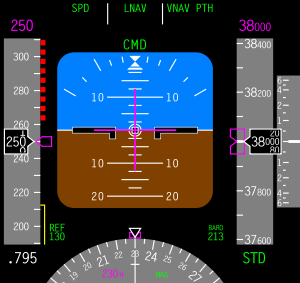
Primary Flight Display (PFD)


A primary flight display or PFD is a modern aircraft instrument dedicated to flight information. Much like multi-function displays, primary flight displays are built around an LCD or CRT display device. Representations of older six pack or "steam gauge" instruments are combined on one compact display, simplifying pilot workflow and streamlining cockpit layouts.


For more  http://avionics0.blogspot.com/2010/11/primary-flight-display-pfd.html